
LPB Piso WiFi 10.0.0.1 Login Admin Portal
Have you ever connected to the LPB Piso WiFi network and asked what 10.0.0.1 is, where to put money, how to stop the remaining time or how to open the admin dashboard? You are certainly not alone. It looks like a rather technical address but it’s not that hard to use when you understand what it actually does.
LPB Piso WiFi 10.0.0.1 will be a regional gateway for a lot of Piso WiFi businesses, permitting consumers to set up compensated web access, accompanied by entry and authority access to significant options in the network, all without requiring much skilled management interaction. It’s not a standard web address and only functions when your device is on the correct local network.
This guide covers everything from 10.0.0.1 Piso WiFi login, pause-time controls, vouchers, bandwidth management, security, common login problems & practical troubleshooting tips as well Whether you are a customer who is purchasing a couple of minutes or a Piso WiFi owner who manages your own vendo machine, below are the steps that you need to follow.
What Is LPB Piso WiFi?
LPB Piso WiFi 10.0.0.1 is an internet vending system that provides prepaid WiFi services in the Philippines and has become a popular option. Rather than forcing every customer to buy a monthly broadband plan, a Piso WiFi operator can offer internet services in smaller, prepaid amounts.
To use the wireless network, users have traditionally had to connect first and then insert coins into a vendo machine which provides internet minutes at rates configured by the operator. This idea enables temporary home representation to be effectively established in local shops, lodges, public venues, micro businesses and public meeting spots.
LPB Piso WiFi 10.0.0.1 is more advanced than the simple coin-op systems many people associate with the term. Currently, the LPB platform promotes quote-to-install for coin-op internet access, cloud-based session time, voucher management and controls on bandwidth & traffic, a remote machine monitoring system with e-payments and sales tracking options, plus customizable customer portals. Instead of being limited to just a standard router, LPB emphasizes support for various hardware platforms.
This is important because LPB Piso WiFi 10.0.0.1 is a system, not just the name of a WiFi router. A typical installation might consist of an ISP internet uplink, a device with LPB compatibility, wireless access equipment, coin devices, etc., and some software and control systems like the captive portal that controls customer sessions. That’s where 10.0.0.1 comes into play, which is the kind of portal for you!
What Is 10.0.0.1 in LPB Piso WiFi?
10.0.0.1 is an IPv4 private LAN address in the range reserved for internal networks. Private address space is defined as 10.0.0.0 through 10.255.255.255 according to the IANA and RFC 1918 specification in the Internet Engineering Task Force (IETF). They are meant for internal networks and not as directly globally routable public Internet addresses.
This means hitting 10.0.0.1 in your browser is a completely different animal than going to Google, Facebook or other public websites. Last but not least, if an LPB Piso WiFi 10.0.0.1 setup configures localhost to 10.0.0.1, then your browser is connected with the device itself over the local WiFi network. This is why LPB Piso WiFi 10.0.0.1 Login usually works only when you are on the suitable Piso WiFi network. The portal might not show up if your phone stays on mobile data or you’re connected to some other wireless network.
LPB Piso WiFi 10.0.0.1 Customer Portal vs Admin Portal
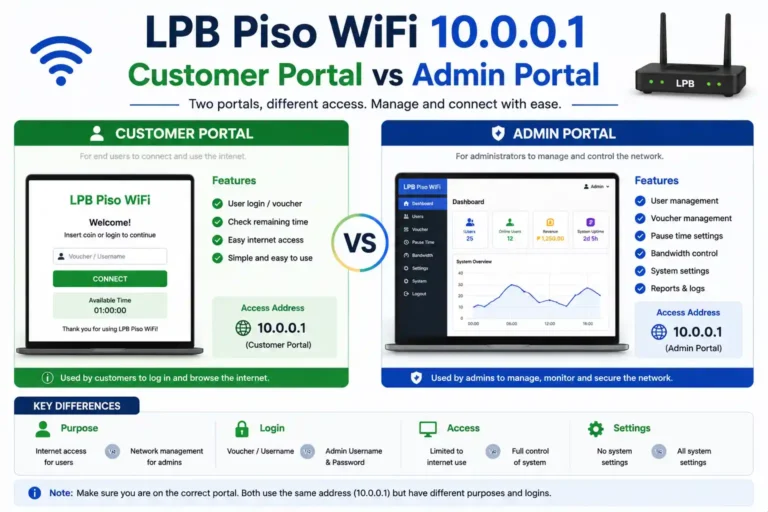
One of the frequent sources of confusion is mixing up the customer portal with the administrator dashboard.
They don’t have to be identical.
Customer Portal: 10.0.0.1
For many LPB configurations, opening:
http://10.0.0.1 takes a client to the Piso WiFi entryway. This page (depending on how the operator sets it up) may allow a customer to add value, purchase internet time, redeem a voucher, check remaining time, pause their session or resume an active session. 10.0.0.1 is commonly described in current and legacy LPB-related guides as the address for the customer-facing portal
Admin Portal: 10.0.0.1/admin
Operators typically access the administrative controls via a path like:
http://10.0.0.1/admin. The admin page is meant for the owner or a responsible person managing the hotspot. An operator could be allowed to configure timers, create vouchers, administer users, view sales information, manage bandwidth or modify system and network settings from this area of the system. Availability is software-version and configuration-dependent. Customers should not try to access the admin dashboard.
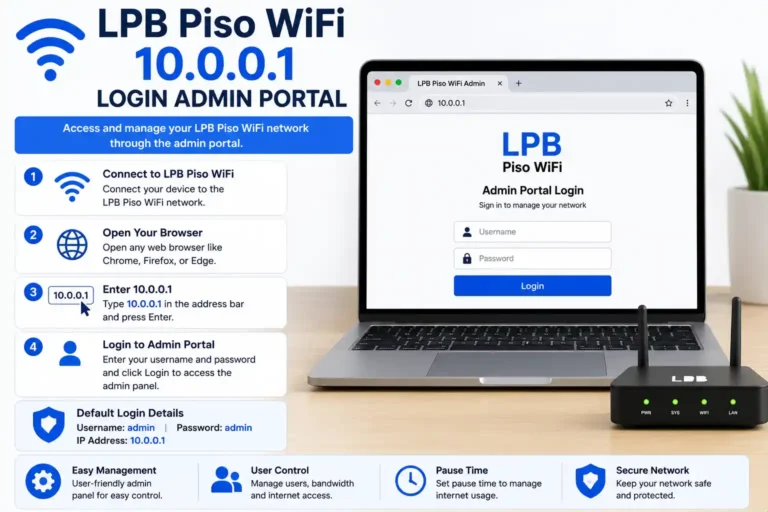
How to Open LPB Piso WiFi 10.0.0.1
- Normally, you can open the LPB Piso WiFi 10.0.0.1 portal easily.
- First, connect your phone, tablet or computer to the appropriate LPB Piso WiFi 10.0.0.1 network.
- Then start Chrome, Safari, Edge, Firefox or another browser.
Tap or click directly within the address bar of a browser and type in:
- http://10.0.0.1
- Press Enter or Go.
- The customer portal of the local environment should show if this address is set up in its system.
Address bar vs. search box: When you surf using a browser, this difference will make sense. Typing “10.0.0.1″ in the Google search engine does not open the local gateway. More reliable is the direct input of an IP in a browser address field.
If the page still does not open, don’t immediately believe that the machine. Mobile data may be used by your device, the gateway could be different or the hotspot may temporarily lose its connectivity or the system was configured with another local address.
How to Use LPB Piso WiFi as a Customer
The exact customer experience depends on how the operator configured the hotspot, but the process generally follows the same pattern.
- Connect to the Piso WiFi SSID first. A browser login page may appear automatically because many public WiFi systems use a captive portal.
- If nothing appears, manually open.
- Once the portal is visible, select the payment or connection option provided by the operator. On coin-operated installations, you may be instructed to insert money into the machine before confirming payment.
- Your purchased time should then be associated with the active session or device according to the system configuration.
- Modern LPB systems also offer more flexible functionality. The official LPB 2.0 site currently describes coin integration, voucher support, time- or data-based packages and GCash/Maya electronic payment capability on supported configurations.
LPB Piso WiFi Pause Time: How It Works
The feature is one reason users frequently search for 10.0.0.1. Suppose you purchased an hour of internet but need to leave your phone for twenty minutes. Without a session-control feature, some prepaid systems could continue counting down even while you are not actively browsing.
Where enabled, pause time provides a way to temporarily stop the applicable session and resume it later. The current LPB platform goes even further by advertising , under which customer session information can be synchronized through LPB’s cloud infrastructure, allowing supported sessions to be paused and resumed across LPB machines.
LPB Piso WiFi 10.0.0.1 Admin Login
- The owner or any authorized administrator of the LPB Piso WiFi 10.0.0.1 machine.
- Locally, connect an authorized device to the appropriate network.
- Open your browser and type the address of the admin area you previously configured for your LPB installation. A commonly documented route is:
- Now provide the username and password for the administrator account set on this machine.
- Redirection to the dashboard or management interface should happen after successful login.
Some LPB guides also list admin / 123456789 as a common default for older or certain installs. But this should not be considered a blanket default credential. A secure machine should reject publicly known defaults and allow versions, installers and operators to change login details.
If you have the system, use the credentials provided with your installation or vendor documentation.
What Can an LPB Piso WiFi Owner Manage?
An LPB installation gives much more granularity than just turning on or off internet access. Now these tools include remote monitoring, bandwidth controls, voucher management, sales and earnings records, time- and data-based plans, PPPoE functionality, e-payments, multi-subvendo configs etc on the existing LPB 2.0 platform as well.
The specific menus will vary depending on your configuration, but there are a few key areas where they come in handy.
Timer and Pricing Rates
- Inside each timer, you set a timer rate, which decides how much internet the customers get for their payment.
- An operator may set one value for a brief period and another for an extended period.
- The important point is consistency. Customers need to know how much time or data they are getting before they pay.
We should therefore be very careful in changing the rates. Before saving, review all values and test in the customer portal to confirm the new package works as intended.
Voucher Generator
- Vouchers are a great tool to use when the operator prefers not to have a customer insert coins at this time.
- Each LPB interface is slightly different, but most let administrators design vouchers by setting price, access time (duration of use), validity and bandwidth or data limits.
Bandwidth and Speed Limits
- Frustration can arise from a shared connection if one device is hogging the bandwidth.
- So let’s say you have ten customers browsing as normal but one user starts a large download. If there is no traffic management, that download might impact other people’s ability to use the Internet.
- LPB now you know that Smart Queue Management, port-specific prioritization and per-customer connection speed limiting, plus time and data limits on a daily or (per) monthly basis.
- Making bandwidth controls that are properly distributed will help share available capacity.
- Operators ought to introduce limits arbitrarily. Think about the ISP connection speed, estimated simultaneous users, as well as common activities on the network.
Connected Users and Sessions
- Session management gives an operator insights into how the hotspot is being utilized.
- The administrator accesses the case to survey active client session information or other system files depending on the LPB version.
- This helps troubleshoot most out-of-the-ordinary congestion or whether service issues are localized to one device or throughout the network.
Sales and Earnings
- Not just a business system but also a kind of network.
- The LPB aspect of this function enables operators to track their machine sales and transactions on a much more systematic basis.
- Operators ought to check digital records against real-life collections or payment activity from time to time instead of relying on memory.
Remote Monitoring
- The owner needs to be near their machines to do lots of administrative work on the Admin App.
- LPB has started promoting integrated remote monitoring in its newer solutions.
- This may lend particular benefit to an operator with multiple machines spread out across various locations.
However, your remote administration should be secured with strong credentials since the greater convenience at the same time means that account security becomes more important.
Is LPB Piso WiFi Safe For Users?
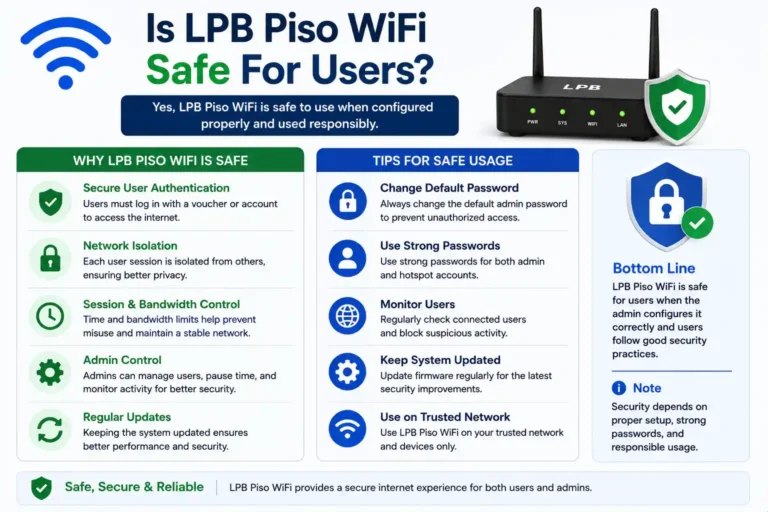
Piso WiFi hot spot is not automatically damaging to the phone, tablet or laptop which it is used with. So with Piso WiFi, you should still treat it as if it were any other shared or public network. Consumers must choose sites and apps that use modern encryption protocols, keep their devices up-to-date, and eliminate the tendency to ignore browser certificate warnings.
For some sensitive activity, like banking or entering important account credentials, if you need to enter them in public passersby could be watching on the unmonitored hotspot but guess what: it is a private mobile connection then using a trusted device with a private mobile connection may offer more control than an unknown public hotspot.
Saying that any public WiFi network is 100% secure would simply be incorrect. The safety significantly relies upon the associated hotspot, web applications and sites being entered by the clients, and the customer’s device among a multitude of different components.
Why 10.0.0.1 Is Not Opening
Unsuccessful 10.0.0.1 Piso WiFi login is typically correctable
Those are the most common causes.
You Are Connected to the Wrong WiFi
- You cannot, because 10.0.0.1 is a private local address and you usually have to be connected to the network that actually uses it.
- Please check WiFi settings and make sure you have picked the correct LPB Piso WiFi 10.0.0.1 SSID.
Mobile Data Is Interfering
- If a WiFi network still provides no internet access, some phones automatically prefer mobile data.
- Temporarily disabling mobile data might enable your browser to directly communicate with the captive portal.
- Then, once you are connected to Piso WiFi, go back and try 10.0.0.1 again
The Address Was Typed Incorrectly
There are many versions of the address that circulate online that are not correct.
The proper address in this format for IPv4 is:
10.0.0.1
Common mistakes include:
- 10.0.0.0.1
- 10.0.01
- 10.0.0.l
- 10.0.0.1.com
The variation 10.0.0.0.1 is what triples the number of distractors, since a common IPv4 address consists of four decimal sections and not five.
You Entered It Into a Search Engine
When putting those numbers into a Google search box, it may yield search results rather than opening the local portal.
Click in the address bar of your browser and type:
http://10.0.0.1 directly.
The Machine Uses Another Gateway
- Everything about Piso WiFi is 10.0.0.1 but private networks can utilize countless distinctive local addresses however normally the one used by these installations is 10.0.0.1
- The 10.0.0.0/8 range contains too many addresses on its own, while other private ranges are specified by 172.16.0.0–172.31.255 and obviously also 192168 = 192,168, (n01) and yes up to the above (B).
- Even if 10.0.0.1 doesn’t work, do not set any random settings. Rather, find out which gateway is being assigned to your device right now.
The LPB Device Needs Attention
When no customer can access the portal from their devices, you might be having issues with the Piso Wi-Fi box (machine) and not an individual phone. An authorized operator has to inspect the LPB device, access point and its cables, the power supply equipment and the upstream ISP connection.
Conclusion
You will have a better understanding of what LPB Piso WiFi 10.0.0.1 is if you realize that 10.0.0.1 is a private local network address and not an Internet website like most everyone else on the Internet realizes already by now! How it Works – For most LPB Piso WiFi 10.0.0.1 installations, it gives members the ability to buy access at advance rates, redeem vouchers, observe sessions, and make use of popular pause time and resume time features.
LPB offers a significantly broader management environment for those who are authorized owners. Depending on the version and configuration, administrators can track rates, vouchers, connected users/network settings, bandwidth sales information and other operational controls. Modern LPB 2.0 has taken this a step even further by adding cloud sessions, remote monitoring, e-payments and business functionality to the system.
If the login page of 10.0.0.1 Piso WiFi does not open, make sure you are connected to the right network, type the IP directly into the browser address bar or better check your true gateway and do not reset it until other simpler procedures have been exhausted.
FAQs
What is LPB Piso WiFi 10.0.0.1?
10.0.0.1 is a Private local IP address to access the customer portal of LPB Piso WiFi 10.0.0.1 in your local network. If this is a paid internet session, the user can manage it through an installation, while owners of that installation are able to access administrative functions.
How do I open the 10.0.0.1 Piso WiFi login?
Now, you would connect to the right LPB Piso WiFi network & open a browser then type http://10.0.0.1 exactly in the address bar.
What is the LPB Piso WiFi 10.0.0.1 admin URL?
One of the documented examples of a local admin path is http://10.0.0.1/admin. The specific way it is administered can differ however based on LPB version and machine configuration.
What is the LPB Piso WiFi 10.0.0.1 default username and password?
Various LPB guides in circulation identify admin as the identity name and 123456789 as a legacy/common default password. These credentials should never be considered valid for all LPB deployments and owners should change known defaults to unique passwords.
Is 10.0.0.1 a public website?
No. It sits in the private 10.0.0.0/8 range of addresses reserved for use by local networks.